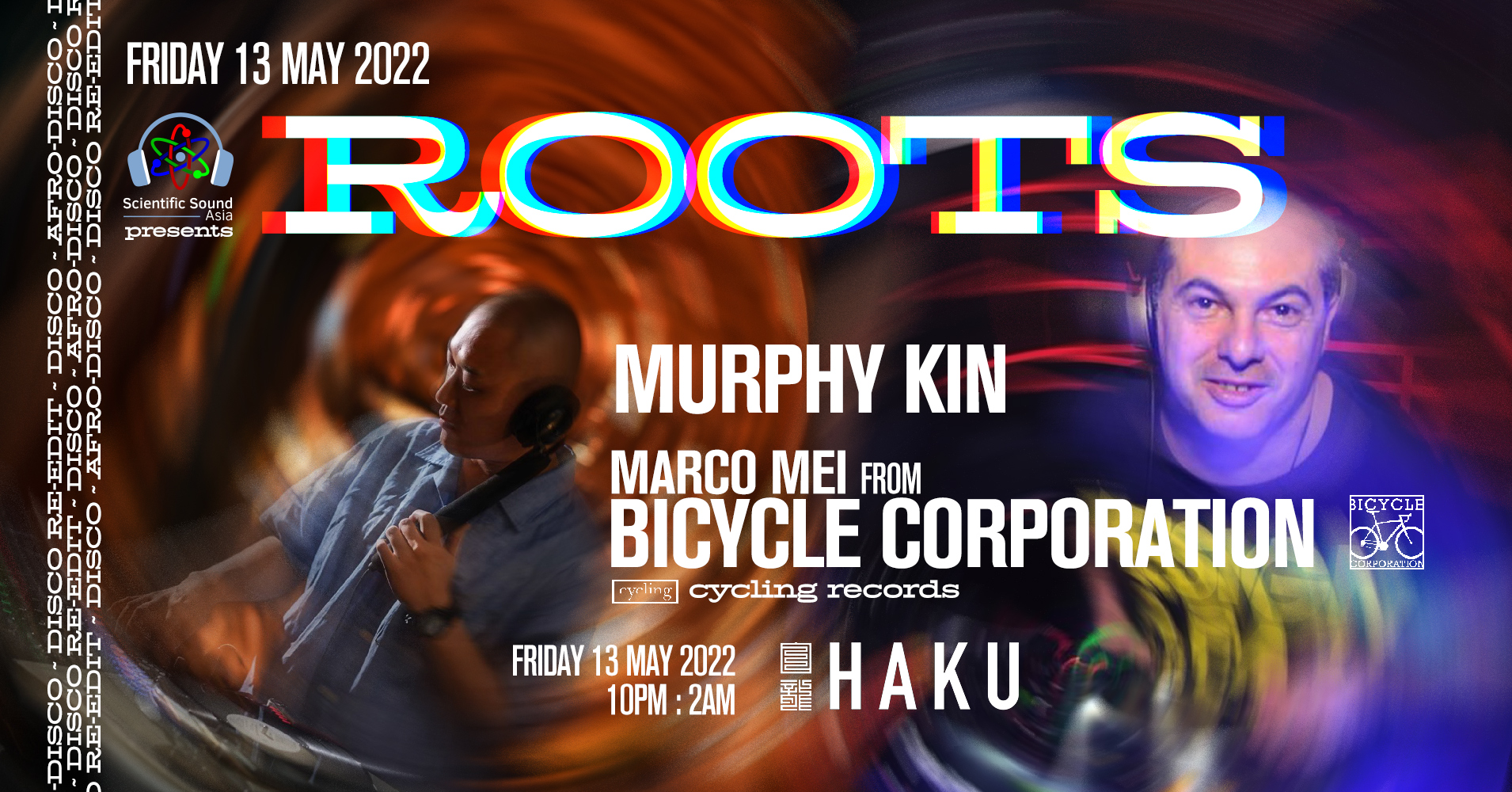
After an unforgettable run as a radio series on Scientific Sound Asia and four successful live editions, Bicycle Corporation and Scientific Sound Asia returned to HAKU Taipei for the fifth edition of Roots. The night continued the established focus on Afrobeat, Nu Disco, Disco and Disco Re-Edits, bringing the warm and groove-led identity of the programme back onto a Taipei dancefloor.
By the fifth edition, Roots had developed into a recognisable club concept rather than simply a live extension of a radio show. Marco Mei and Murphy Kin remained at the centre, allowing each event to develop through different records while retaining the same musical philosophy.
The series originally grew from Scientific Sound Asia Radio, where Bicycle Corporation used Roots to explore music outside the harder House and Techno associated with some of their other work. Afrobeat, Disco, Nu Disco, Funk, Soul and re-edits gave the programme a warmer identity while keeping rhythm and dancefloor movement at its core.
Bringing the radio concept into HAKU Taipei allowed those musical ideas to operate in a physical club environment. Instead of selecting for an international broadcast audience, the DJs could respond directly to the room and let the night develop according to the people on the dancefloor.
Italian DJ and producer Marco Mei returned for the fifth edition with more than three decades of international experience behind the decks. Based in Taipei, his career had taken him through clubs, festivals and underground music scenes across Europe, Asia and other parts of the world.
Marco is also one half of Bicycle Corporation alongside Italian producer Stefano Ugliano, also known as 6884. While the production project has covered House, Techno and related electronic styles, Marco’s DJ sets extend through Deep House, Disco House, Nu Disco, Tech House and a much wider range of groove-led dance music.
That broader collection remained important to the identity of Roots. The series allowed Marco to move away from rigid peak-time programming and follow connections between Afro-influenced rhythms, Funk, Disco, modern House and contemporary reworks.
Disco remained one of the main foundations because so much later club music developed from its structures and instrumentation. Basslines, strings, percussion, soulful vocals and extended arrangements all became part of a musical language later absorbed into House and other forms of electronic dance music.
Nu Disco provided a contemporary route back into that tradition. Modern producers could retain the warmth and musicality associated with classic Disco while adapting those influences for current production techniques, DJs and club sound systems.
Disco Re-Edits formed another important part of the Roots sound by giving older recordings a new function within contemporary sets. Extended introductions, restructured breakdowns and longer instrumental sections could make familiar music easier to mix without removing the character of the original recordings.
Afrobeat added a different rhythmic language to the programme and broadened the idea of what the musical “roots” behind modern club culture could include. Layered percussion, repeated grooves and live instrumentation allowed Afrobeat selections to connect naturally with Funk, Disco and House.
Marco’s experience as a selector gave him the ability to make those relationships audible without treating the genres as isolated sections. A rhythm or bassline could guide the movement from one musical tradition into another while the dancefloor remained the main consideration.
Murphy Kin returned alongside Marco Mei and brought another broad musical perspective to the fifth edition. The Taipei-based DJ, music curator and record-label figure had built a long history across House, Disco and independent club culture in the region.
Originally from Shanghai and later based in Taipei, Murphy had worked through bars, clubs, parties and music-curation projects across both cities. That background gave him an approach based on record selection and musical context rather than allegiance to a single scene.
Murphy Kin has also been known as DJ Lucy and became connected with disco-focused events and music curation around the region. His wider interests stretched through House, Soul, Jazz, R&B, Hip Hop, Rock and other styles, giving his sets a deliberately broad foundation.
Within Roots, that range could be channelled towards warmer dancefloor music and records built around rhythm, melody and groove. Older Disco could sit beside House, an Afro-influenced track could lead towards Funk, and a contemporary re-edit could give familiar source material a new direction.
The partnership between Marco and Murphy worked because the two selectors shared enough musical ground to maintain continuity without approaching it identically. Disco and House provided common foundations, while individual influences and record collections gave each edition room to develop differently.
By the fifth event, that relationship had become part of the identity of Roots itself. Returning audiences could expect Marco Mei and Murphy Kin rather than a constantly changing headline structure, allowing the musical chemistry between them to become one of the main attractions.
The continuity also separated Roots from nights built around novelty or a different guest every month. Its development came from new records, different combinations and the ability of two experienced selectors to revisit the same broad territory without repeating the exact same set.
HAKU Taipei gave the series a consistent physical home while Scientific Sound Asia Radio maintained the broadcast connection. The same musical concept could therefore exist both as a club event in Taiwan and as a programme reaching listeners elsewhere in Asia and internationally.
That relationship between radio and nightlife remained one of the strongest parts of Roots. Listeners could first hear the musical approach through Bicycle Corporation’s broadcasts before encountering Marco Mei and Murphy Kin working with the same influences in a room full of dancers.
For Bicycle Corporation, the series also highlighted musical roots that sat behind its House and electronic production work. Funk, Disco, Afrobeat and Soul could be presented directly rather than appearing only as subtle influences inside newer electronic records.
The fifth edition did not need a new musical identity because the concept was already well established. Its development came from the selectors digging further into Afrobeat, Nu Disco, Disco and re-edit culture while retaining the warmth and accessibility of the previous nights.
Afrobeat remained especially useful as a rhythmic bridge between several traditions represented at the event. Its percussion and repeated instrumental figures could move naturally towards Funk and Disco while also showing connections with later forms of dance music.
Disco continued to demonstrate how older records could remain effective on contemporary dancefloors when chosen carefully. The genre’s combination of groove, live musicianship and extended arrangements still provided material capable of sounding powerful alongside modern production.
Nu Disco added another generational layer by allowing new producers to work directly with those influences. Contemporary technology could sit alongside Disco-derived basslines, strings and vocals without turning the music into a simple recreation of the past.
Re-edits gave both selectors another practical tool for connecting those eras. Older tracks could be reshaped for longer mixes and modern club structures while retaining the hooks, instrumentation or vocal passages that made the source recordings distinctive.
The invitation to dress cool, dress sassy, dance and feel free remained perfectly suited to the fifth edition. Roots was never presented as an academic exploration of musical history, even though both DJs brought deep collections and decades of experience to the booth.
The purpose remained straightforward movement and enjoyment. Historical influences were heard through the records themselves rather than explained, allowing basslines, percussion and vocals to carry the musical connections naturally.
Scientific Sound Asia continues to connect this history through its current events, radio station, DJ agency and music news sections. The Taipei editions of Roots show how the organisation could extend a radio concept into a recurring physical event elsewhere in Asia while maintaining the same artists and musical direction.
Marco Mei’s continuing relationship with the platform provides a direct link between these HAKU events and Scientific Sound Asia today. His DJ agency profile documents the international career behind his long-running work with Bicycle Corporation, radio programming and club events.
Murphy Kin likewise became a recurring contributor rather than a one-off guest attached to the first editions. His continuing role strengthened the relationship between Taipei’s club community and the international audience following the Roots programme through Scientific Sound Asia.
By its fifth edition, Roots had become a firmly established meeting point between radio, club culture and musical history. Marco Mei and Murphy Kin returned to HAKU Taipei with Afrobeat, Nu Disco, Disco and Disco Re-Edits, keeping the focus on warm rhythms, deep selections and a dancefloor driven by groove.
Roots 5 therefore continued the same simple principle that had carried the series through its earlier editions. Dress cool, dress sassy, dance and feel free remained the invitation, while Marco Mei and Murphy Kin supplied the records capable of making that instruction easy to follow.
Haku Taipei, No. 1號, Yumen Street, Zhongshan District, Taipei City, Taiwan 10491
Date: Friday 13 May 2022, 12:00 AM
Venue: Haku Taipei
Price: Free