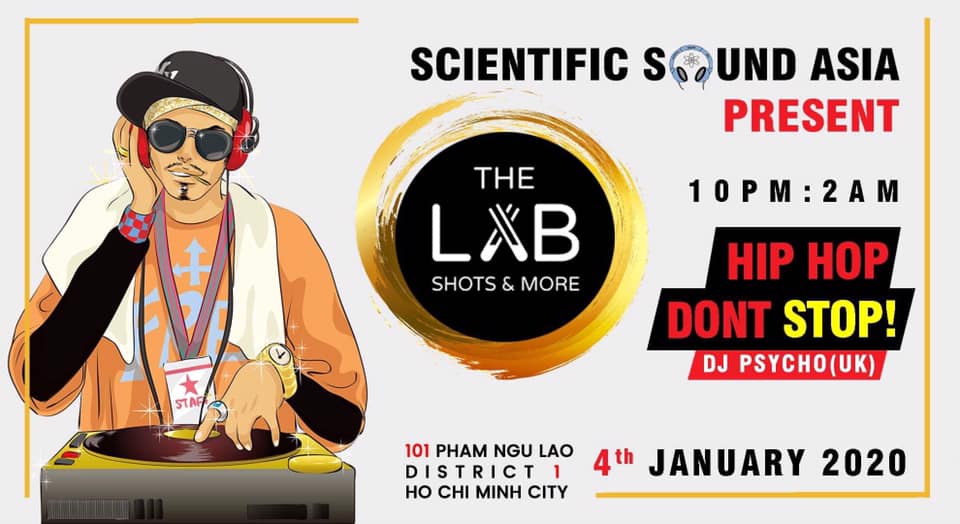
This event took place at The Lab - Shots & More, 101 Phạm Ngũ Lão, Phường Phạm Ngũ Lão, Quận 1, Ho Chi Minh City, from 9 PM on 4 January 2020 until 2 AM on 5 January 2020, with the original location retained for archive accuracy even though the venue has since closed. Scientific Sound Asia returned to the District 1 venue for the second edition of Hip-Hop Don’t Stop, continuing the series with Old School selections, New School flavours and free-entry rooftop energy.
The event followed the first Hip-Hop Don’t Stop night held at The Lab in November 2019 and kept the concept deliberately straightforward. Hip Hop remained at the centre of the programme, with the second edition placing greater emphasis on classic records, vinyl and the foundations of DJ culture.
Entry was completely free, allowing guests to arrive throughout the five-hour session without needing an advance ticket. The format suited a relaxed Saturday night where people could move between the music, drinks and different areas of the venue rather than committing to a formal club programme.
The Lab offered several spaces across the building, including its first-floor bar and rooftop terrace. Guests could head upstairs to dance beneath the Saigon night sky or remain inside and listen to the music in a more relaxed setting.
The venue’s laboratory theme gave the party another distinctive visual identity within the Phạm Ngũ Lão nightlife area. More than 100 different shots were advertised alongside cocktails, balloons and beers, while three floors and two separate bars gave the building several different social areas.
The rooftop was one of the main attractions and helped distinguish Hip-Hop Don’t Stop from a conventional enclosed nightclub event. It gave the crowd somewhere to dance, talk and move around while the music continued without the atmosphere becoming overly formal.
Musically, the night returned to Hip Hop across different periods of the genre. Old School records sat alongside newer material, creating a programme that acknowledged the music’s history without turning the event into a nostalgia session.
The second edition was also more closely focused around DJ Psycho-UK and his vinyl collection. Rather than relying on a larger line-up, the night gave him room to dig through classic Hip Hop records and build a longer selection around music that had influenced him since his teenage years.
DJ Psycho-UK, also known as Bearhead, began DJing at the age of fourteen in East London. His first set-up consisted of a pair of Soundlab DLP1 turntables and a four-track mixer, giving him a traditional hands-on introduction to mixing and record collecting.
Hip Hop was one of the earliest foundations of his musical background and remained connected with everything that followed. As House, Acid House, Hardcore, Jungle and Drum and Bass developed around the UK underground, his DJing expanded into those scenes without abandoning his original interest in rap and turntable culture.
Growing up in East London placed him close to a period when Hip Hop, pirate radio, warehouse parties and imported American dance music were all feeding into the development of new British scenes. Records and tapes circulated between DJs and listeners before many of those sounds gained wider commercial recognition.
DJ Psycho-UK later played on London pirate stations including AXE FM and Fantasy FM. Pirate radio gave underground DJs a way to reach listeners directly and played an important part in the growth of House, Hardcore, Jungle and Drum and Bass alongside the Hip Hop culture that had influenced many of the selectors involved.
His wider underground activity included warehouse events, squat parties and the party networks operating around crews such as Outcry Syndicate, OTT and London Overground. Those environments placed record selection, sound systems and DJ technique at the centre of nights that often operated outside the mainstream club circuit.
That history also meant vinyl remained more than a decorative part of his DJ identity. For Hip-Hop Don’t Stop – 2nd Edition, the records themselves became a central part of the programme, connecting the event directly with the way Hip Hop DJs had traditionally worked behind the decks.
Old School Hip Hop selections gave the night a strong connection with the genre’s earlier decades. Breaks, beats, familiar vocal records and party cuts could all sit together without requiring the music to remain locked to one particular year or region.
The New School side of the event kept the selection from becoming entirely historical. More recent tracks could appear alongside older records, allowing the night to show how Hip Hop had changed while preserving the rhythmic and lyrical foundations linking different generations.
DJ Psycho-UK’s broader career eventually took him outside the United Kingdom to the West Indies, Australia and Vietnam. His ability to move between Hip Hop, House, Jungle, Drum and Bass and other underground styles allowed him to adapt his selections to very different promoters, venues and audiences.
In London, his appearances included venues such as Scala, Bagley’s Film Studios, 491 Gallery, 291 Gallery and 333. These performances placed him across different parts of the capital’s underground nightlife before his later relocation to Asia.
After becoming based in Vietnam, he appeared at venues and events including Piu Piu, Basement, Indika, Cargo Remote, Pogo Beach Club and Dragon Beach. His Ho Chi Minh City activity also increasingly combined DJing with event organisation and the development of Scientific Sound Asia.
Scientific Sound Asia grew from those activities into a wider platform connecting underground music through broadcasting, artist representation and events. The organisation now operates through its radio station, DJ agency, events archive and music news.
The Hip-Hop Don’t Stop series gave that wider platform a dedicated outlet for rap music within Ho Chi Minh City. Scientific Sound Asia was already active with House, Techno, Drum and Bass and international touring artists, but these nights placed Hip Hop firmly at the centre rather than using it as part of a broader multi-genre event.
The series also followed earlier Scientific Sound Asia bookings connected with Hip Hop and turntablism. Events involving Too Many T’s, JFB and Swing Master J had already demonstrated the organisation’s interest in rap, scratching, Funk and DJ culture alongside its electronic music programming.
At The Lab, however, the format was deliberately smaller and more informal than those international guest events. Free entry, a rooftop and a long vinyl selection made the night feel closer to a regular Hip Hop gathering than a headline concert or touring-artist showcase.
That simplicity was part of the appeal of the second edition. There was no need for a complicated theme or elaborate production when a collection of records, a sound system and a rooftop crowd could provide the structure for the night.
The Phạm Ngũ Lão location also placed Hip-Hop Don’t Stop in one of central Ho Chi Minh City’s busiest nightlife areas. Visitors moving through District 1 could discover the event easily, while regular followers of Scientific Sound Asia had another opportunity to hear a side of the organisation’s music policy that was not always represented at its electronic events.
The Lab - Shots & More has since closed, making the original address part of Ho Chi Minh City’s nightlife history rather than a current destination. Preserving these event details helps document the smaller bars, rooftops and independent venues that provided space for underground music around the city.
Hip-Hop Don’t Stop – 2nd Edition returned to the essential ingredients of the first event while giving vinyl and Old School Hip Hop a stronger role. With free entry, three floors, two bars and a rooftop, The Lab provided the setting while DJ Psycho-UK supplied the records that carried the party from Saturday night into the early hours of Sunday morning.
The Lab - Shots & More, 101 Phạm Ngũ Lão, Phường Phạm Ngũ Lão, Quận 1, Ho Chi Minh City, Vietnam
Date: Saturday 4 January 2020, 12:00 AM
Venue: The lab Shots and More