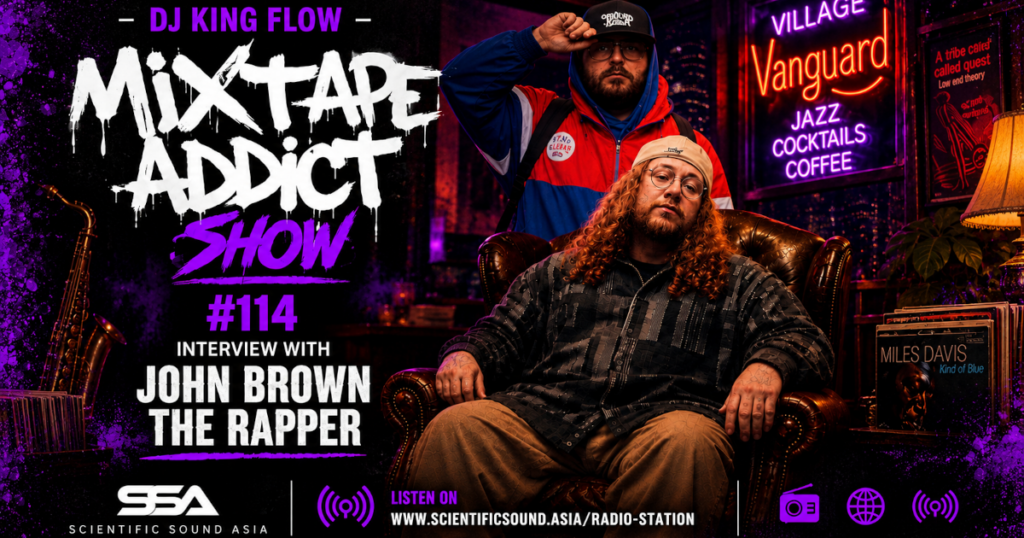
French DJ and producer DJ King Flow returns with another edition of Mixtape Addict, this time featuring John Brown The Rapper on Scientific Sound Asia. Scientific Sound Asia operates as an international radio station, promoter, DJ agency and music news platform supporting artists connected with both the foundations and continuing development of Hip Hop culture.
DJ King Flow began DJing at the age of fourteen and developed a style firmly rooted in Boom Bap. The influence of 1990s Hip Hop remains central to his approach, although his selections consistently place newer underground artists alongside established names rather than treating the music purely as nostalgia.
That connection between generations has become an important part of his identity as both a selector and producer. Hard drums, sample-driven production and lyric-focused records sit alongside contemporary independent releases from artists continuing those traditions across different parts of the world.
His career has included collaborations with established names including Ras Kass, Tragedy Khadafi, O.C., Juicy J and Khujo Goodie. These projects reflect a long-term commitment to the foundations of the culture while keeping his production work connected with artists active across the present underground scene.
In 2015, DJ King Flow launched Mixtape Addict as a platform dedicated to independent Hip Hop. What began around mixtapes and radio developed into a wider project combining regular broadcasts, artist interviews, new music and direct support for rappers, DJs and producers.
The interview side of Mixtape Addict has become an important part of the project because it gives artists more space to discuss their careers, influences and current work. These conversations sit alongside the music and provide listeners with additional context around the people, labels and independent networks behind many of the records featured on the programme.
DJ King Flow’s wider activity can be followed through Facebook, X and the Mixtape Addict YouTube channel. These platforms extend the project beyond radio through interviews, videos, releases and other material connected with the international underground.
Production has also become an increasingly visible part of his work. His instrumental album The Adventures of F.J. Parker combines Jazz-influenced melodies, soulful textures and deep grooves with the raw drum-led character associated with classic beatmaking.
Trill Legacy (Instrumentals) developed that side of his catalogue further by placing the emphasis entirely on his production. Without an MC at the centre, the project gives the arrangements, samples, drums and melodic ideas more room to demonstrate how his style operates independently.
His collaborative releases continue to connect that production work with underground rappers from different scenes. Warzone featuring Ice Crimi, Win or Lose featuring Imam T.H.U.G. and Money with Lex Lakaiser show how his beats can support contrasting vocal approaches while retaining a recognisable identity.
More recent work includes Back To Basics (Mixtape Addict) featuring Faf Larage, Napoleon Da Legend, Relo and DJ Djel. The project brings several voices together around the musical principles that have remained central to DJ King Flow’s work since his earliest years behind the decks.
Bills (Remix) featuring Khujo Goodie extended his connection with established American artists, while Laser Rouge with Omaz and Joe Mack returned to the collaborative underground format that runs throughout his catalogue. The Movement featuring ISH-ONE added another international connection and reinforced the global outlook behind Mixtape Addict.
That international direction also appears through Legacy with Dnzl Izm and Northwest Flow with Seattle emcee King Khazm. Rather than concentrating exclusively on French or American artists, DJ King Flow uses Mixtape Addict to connect independent voices from different locations through a shared respect for lyricism, beatmaking and underground culture.
This edition continues that approach with John Brown The Rapper joining the programme as the featured artist. His appearance fits naturally within Mixtape Addict’s focus on lyric-driven underground Hip Hop and artists carrying traditional MC culture into the present.
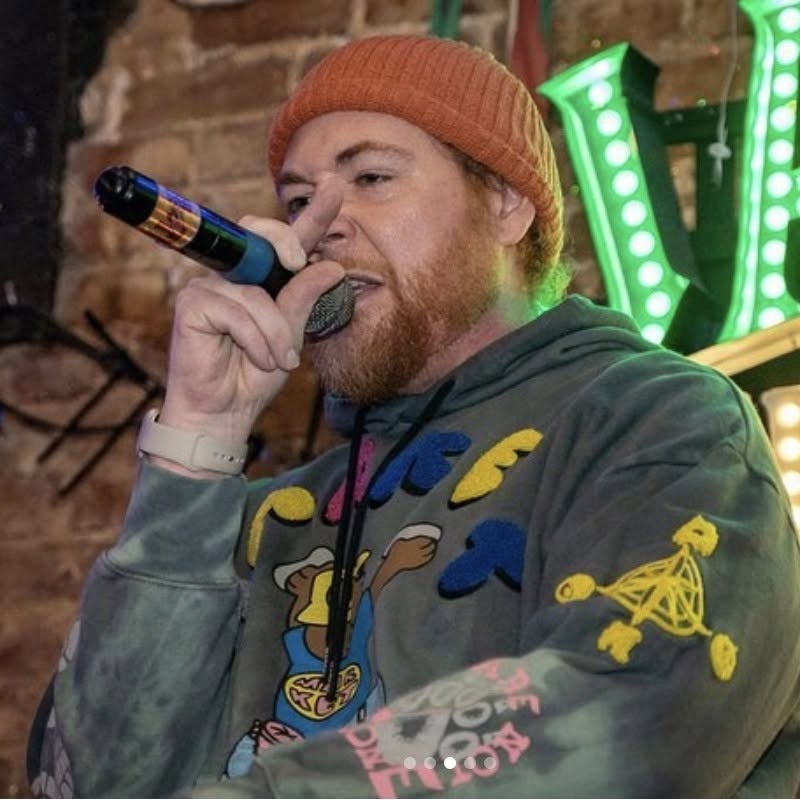
Interview Guest: DJ John Brown The Rapper.
John Brown The Rapper is an underground Hip Hop artist whose work is built around lyricism, storytelling and a strong connection with the foundations of Boom Bap. His approach places the emphasis on writing, character and substance, giving his music a clear identity within contemporary independent Hip Hop.
His catalogue includes projects such as The Harper’s Ferry Insurrection, Planting Seeds, Tragic Johnson, Free Manna From Mecca and Pulling Weeds. Across these releases, John Brown has developed a style centred on dense verses, reflective writing and production that allows the vocal performance to remain at the forefront.
That focus on lyricism has also shaped the way he has continued to develop as an artist. His work draws from the traditions of East Coast and conscious Hip Hop while maintaining a present-day independent approach rather than relying purely on nostalgia.
A significant recent stage in his career has been his work with Da Beatminerz, one of the most respected production teams associated with underground New York Hip Hop. Their collaboration has given John Brown access to a darker, sample-driven production style that fits naturally with his delivery and writing.
The partnership produced Waxing in Mecca, a substantial project that brings his lyricism together with Da Beatminerz’ established production aesthetic. The release also connects him with artists including Smif-N-Wessun, Your Old Droog, O.C. and Rockness Monsta, placing his work alongside several respected names from the wider underground scene.
He has also released material such as Extraordinary with Da Beatminerz, further developing that collaboration. These projects show a clear progression in his catalogue while keeping the emphasis on bars, production and traditional Hip Hop structure.
John Brown has additionally spent time developing his writing through Pendulum Ink, a programme focused on lyricism and the craft of MCing. That background reinforces the technical attention given to structure, rhyme and narrative throughout his work.
Rather than chasing mainstream trends, John Brown The Rapper has continued to build his profile through independent releases and collaborations with artists and producers who share a similar respect for Hip Hop’s foundations. His music remains centred on the MC, with production serving the writing rather than overwhelming it.
His current work places him firmly within the contemporary underground Hip Hop scene while maintaining a clear link with the traditions that influenced him. Through detailed lyricism, concept-driven projects and collaborations with established producers, John Brown continues to develop a catalogue focused on substance and long-term artistic identity.
DJ King Flow opens Mixtape Addict Show Episode 114 with three tracks from John Brown The Rapper and Da Beatminerz, immediately setting a strong Boom Bap and New York underground direction. "Extraordinary", "The Joint" with Craig G and "Waxing In Mecca" with Smif N Wessun lean into Brooklyn-rooted production, hard drums and lyrical delivery rather than a broader mainstream rap sound.
AFRO continues the lyric-focused approach with "All Flows Reach Out" before JR Writer and Hell Rell bring the programme into a tougher East Coast Hip Hop lane shaped by Harlem street rap and Dipset-era energy. Cory Gunz with OT The Real and Nutso keep that New York emphasis intact, adding Bronx and Queens voices to a run centred on punchlines, direct delivery and rugged production.
ParkaOne and Maky Lavender add a different regional character with "Reste Calme", while M-Dot and Kore's "All The Same" reinforces the underground East Coast thread through Boston-rooted lyricism. Ras Kass and Ab-Soul then shift the geography westward with "Latency", introducing West Coast Hip Hop through two artists known for dense writing and concept-driven bars rather than purely commercial production.
Baron Von Alias with Keith Murray and Tash connects East and West Coast voices before DJ Premier and The Alchemist bring the episode firmly back towards Underground Hip Hop and sample-led production with "For The Gig". Xzibit, B-Real and Demrick strengthen the California side of the programme through "SK Anthem", adding a harder West Coast street-rap tone before DJ King Flow enters the closing musical stretch.
DJ King Flow's collaborations with Ish-One on "The Movement" and King Khazm with Silver Shadow D on "META" bring the episode to its final music selections with an independent, international underground focus. The programme then closes with DJ King Flow interviewing John Brown The Rapper, extending the opening Brooklyn and New York theme beyond the tracklist and into conversation about the artist behind the music.
DJ King Flow welcomed John Brown the Rapper to Mixtape Addict for an extended conversation about DJ culture, mixtapes, lyricism, collaboration and the role Hip Hop has played in his life. John Brown approached the discussion as both an MC and long-time student of the culture, repeatedly returning to the importance of learning from its foundations while still creating something personal in the present.
Asked to choose his favourite DJ, John Brown ultimately selected Grandmaster Flash while also acknowledging figures including Mr. Sinister, Funkmaster Flex, Tony Touch, Ron G, Marley Marl and Da Beatminerz. He argued that modern DJs and rappers may have access to more techniques and technology, but none of that would exist without the pioneers who established the culture and created the foundations later generations developed.
John Brown also revealed that DJing was one of the elements of Hip Hop he pursued seriously alongside rapping, describing himself as stronger behind the decks than he ever was at breaking or graffiti. He still enjoys selecting and organising music for other people, viewing a DJ as someone who controls the atmosphere and effectively narrates the direction of a set.
The traditional mixtape era remains especially important to him because it gave listeners a place to discover established artists, unknown MCs, blends, remixes and exclusive freestyles within the same recording. He remembered mixtapes as a form of musical discovery where a trusted DJ could place unfamiliar material beside recognised records and gradually introduce listeners to music they might otherwise have ignored.
John Brown also believes the physical nature of cassettes encouraged listeners to give records more time because skipping a track required considerably more effort than it does on a streaming service. Songs that initially failed to connect could become favourites after repeated plays, which he feels is increasingly difficult in an era where listeners can abandon a track within seconds.
For him, a strong mixtape begins with thoughtful selection and a sense of cohesion between records rather than simply placing popular tracks next to each other. He also listens closely to technical details such as beat juggling, tempo changes and the ability of a DJ to highlight a particular lyric or section of a record in a way that changes how the audience hears it.
John Brown argued that the greatest selectors can also introduce records from outside the audience's expected musical world without disrupting the set. He recalled hearing Mr. Walt unexpectedly introduce Toto into a Hip Hop set, describing the moment as an example of how an experienced DJ can make a selection that appears unlikely on paper feel completely natural in the room.
A major section of the interview focused on John Brown's collaboration with Mr. Walt and Evil Dee of Da Beatminerz, which began after he contacted Mr. Walt online about a beat tape. What started with the purchase of one instrumental developed into studio sessions, several songs and eventually the 18-track album Waxing in Mecca, with further unreleased material also created during their time working together.
As the relationship developed, Da Beatminerz began producing music specifically for John Brown rather than simply presenting him with existing beats. That process created enough mutual trust for all three artists to experiment outside their usual approaches, while John Brown refused to simplify his writing simply because some of his references or ideas might require closer attention from the listener.
Working with Mr. Walt and Evil Dee also changed the way John Brown thinks about completing records. He credited them with teaching him to keep revisiting a mix across different speakers and environments, making adjustments until a record is genuinely finished instead of accepting the first version that appears complete.
John Brown described the opportunity to make a full project with Da Beatminerz as something his younger self would have considered a dream come true. Rather than taking that achievement for granted, he connected it to years of work and to the discipline required not merely to begin creative projects but to complete them properly.
King Flow also proposed the idea of John Brown recording a mixtape over classic and contemporary Da Beatminerz production before the next full project arrives. Brown immediately responded positively, explaining that he writes constantly and already has enough material to fill such a release if the idea develops further.
Their discussion extended into Hip Hop's ability to absorb material from virtually any musical tradition through sampling, rhythm and reinterpretation. John Brown described that openness as one of the culture's defining strengths, because Hip Hop can introduce listeners to music, ideas and influences that may have existed far outside their normal listening habits.
When the conversation turned towards younger MCs, John Brown stressed that serious rappers should listen widely and study the techniques of artists who came before them. He recalled memorising and performing verses by MCs including Buckshot, Mos Def and Black Thought as a way of understanding delivery and technique before applying those lessons to his own original writing.
He warned younger artists against simply reproducing whichever style happens to be popular at the time, arguing that individuality was one of the qualities that gave earlier Boom Bap records their lasting appeal. His advice was to study established techniques, understand how accomplished MCs construct verses and then develop an identifiable voice rather than becoming an imitation of someone already successful.
John Brown also discussed his involvement with Pendulum Ink, a programme associated with Mickey Factz, Chilla Jones and other writers that examines the technical mechanics of rap. He explained how identifying devices such as wordplay, rhyme structures and specialised writing techniques can help MCs become more deliberate with their verses while still keeping the overall meaning understandable.
His interest in writing extends beyond rap into literature and structured creative exercises, including techniques built around deliberate limitations. John Brown argued that constraints can sometimes generate stronger ideas because they force a writer to solve problems differently, linking contemporary MC technique with writing traditions that existed long before Hip Hop.
The interview closed with John Brown explaining how Hip Hop has expanded his knowledge throughout his life, from tracing samples back to unfamiliar music to looking up words he first encountered in rap lyrics. He credited the culture with making him more curious and knowledgeable, while thanking everyone who continues contributing as a DJ, rapper, producer, writer, artist or supporter.
John Brown finished with a strong defence of the contemporary underground, arguing that the independent community no longer needs mainstream corporate approval to prove its value. His message was for people to keep making beats, DJing, writing graffiti, rapping and participating at whatever level suits them, because supporting one another and contributing to the culture matters more than chasing somebody else's definition of success.
The live broadcast is scheduled for Tuesday, September 15th, 2026, from 8 to 9 PM Indochina Time (ICT), with a replay set for Saturday from 8 to 9 AM (ICT).
DJ King Flow – Mixtape Addict Show Episode 114
John Brown The Rapper & Da Beatminerz - Extraordinary
John Brown The Rapper & Da Beatminerz - The Joint feat. Craig G
John Brown The Rapper & Da Beatminerz - Waxing In Mecca feat. Smif N Wessun
AFRO - All Flows Reach Out (Prod. Tylr C)
JR Writer & Hell Rell - I Will Not Lose
Cory Gunz & OT The Real - Livin Proof
Nutso - Redemption
ParkaOne - Reste Calme feat. Maky Lavender
M-Dot & Kore - All The Same (Prod. Rawmatik)
Ras Kass & Ab-Soul - Latency feat. Dina Rae
Baron Von Alias, Keith Murray & Tash - Lost In Translation
DJ Premier & The Alchemist - For The Gig
Xzibit, B-Real & Demrick - SK Anthem
DJ King Flow & Ish-One - The Movement
DJ King Flow, King Khazm & Silver Shadow D - META
DJ King Flow - Interview With John Brown The Rapper
Listen Here.